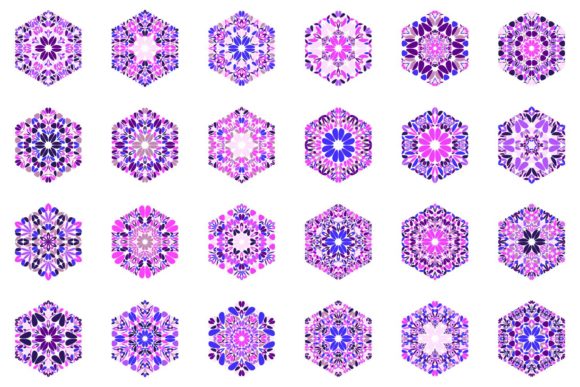
24 Floral Hexagon Designs: Integrating Organic Geometry into Professional Visual Assets
The Intersection of Botanical Art and Geometric Precision
In the realm of graphic design and visual communication, there exists a perpetual tension between organic fluidity and structural order. Designers often seek to balance the softness of natural forms with the reliability of geometric grids. The 24 Floral Hexagon Designs collection addresses this specific aesthetic challenge by merging botanical motifs with the six-sided polygon. This synthesis creates a visual language that is both disciplined and decorative, making it suitable for a wide array of professional and creative applications.
Unlike standard circular floral patterns or rigid square tiles, the hexagon offers unique tiling capabilities and symbolic weight. In nature, the hexagon represents efficiency and strength, most notably seen in honeycomb structures. When combined with ornamental abstract geometrical vector elements derived from curved shapes, the result is a template set that transcends simple decoration. It becomes a functional design system capable of conveying sophistication, growth, and stability simultaneously.
Technical Specifications and File Format Versatility
For professionals working across different media, file flexibility is non-negotiable. This template set is engineered to support high-fidelity output through multiple formats. The inclusion of vector EPS and vector AI files ensures that designers can scale these floral hexagon symbols infinitely without pixelation. Whether applied to a business card or a large-format trade show banner, the mathematical precision of the vector paths remains intact. This scalability is essential for branding projects where consistency across touchpoints is mandatory.
Additionally, the provision of a JPG 7500x5000 raster file serves immediate needs for digital mockups, web backgrounds, and rapid prototyping. At this resolution, the image retains sufficient detail for high-DPI screens and print proofs while remaining manageable for software that may struggle with complex vector rendering. This dual-format approach acknowledges the varied workflows of modern creators, from hobbyists using basic photo editors to agency art directors utilizing industry-standard vector software.
Strategic Applications Across Industries
The utility of ornamental hexagonal templates extends far beyond generic background usage. Specific sectors benefit uniquely from this blend of geometry and flora.
Branding and Corporate Identity
Corporate identity often struggles to appear approachable without sacrificing authority. The hexagonal frame provides a container that suggests technological competence and structural integrity, while the internal floral curves soften the message. Businesses in wellness, sustainable technology, and organic cosmetics frequently utilize these 24 designs to create logos and brand marks that communicate eco-friendly values within a professional framework. The geometric boundary acts as a visual anchor, preventing the floral elements from appearing too whimsical for serious commerce.
Packaging and Label Design
In retail environments, shelf impact relies on pattern recognition. Hexagonal packaging creates an interlocking mosaic effect that draws the eye more effectively than rectangular boxes. Using these floral hexagon symbols as repeating patterns on labels, tissue paper, or shopping bags establishes a cohesive unboxing experience. The curved shapes within the set allow for variation; designers can alternate between dense and sparse floral arrangements to create rhythm on packaging surfaces without breaking the underlying grid structure.
Event Stationery and Textile Printing
Wedding planners and textile designers value the seamless tiling potential of hexagons. Unlike circles, which leave negative space when tiled, hexagons tessellate perfectly. This makes the 24 Floral Hexagon Designs ideal for creating continuous surface patterns for table linens, wallpaper, or invitation suites. The ornamental nature of the vectors allows for customization; individual petals or leaves can be recolored or rearranged within the AI file to match specific seasonal palettes or fabric dye lots.
Design Principles for Effective Implementation
Owning a high-quality asset library is only the first step; understanding how to manipulate these elements determines the final quality of the work. Several key principles govern the successful application of floral geometric hybrids.
- Hierarchy Through Density: Not all 24 designs should carry equal visual weight. Select simpler, more open hexagons for areas requiring text overlay, and reserve the intricate, densely packed floral symbols for focal points or borders.
- Color Theory Integration: While the base vectors may be monochromatic, their effectiveness relies on color strategy. Muted, desaturated tones enhance the vintage ornamental feel, whereas high-contrast neon colors push the design toward contemporary abstraction. Always test colorways in both RGB and CMYK modes if the project spans digital and print.
- Negative Space Management: The spaces between the floral curves are as important as the lines themselves. In vector editing, adjusting the stroke width or expanding the shapes can alter the ratio of positive to negative space, fundamentally changing the texture of the pattern.
- Contextual Scaling: A hexagon that looks elegant at three inches may become visually noisy at twelve inches. Always evaluate the design at actual size before finalizing production files.
Customization Within Vector Environments
The true power of the vector AI and EPS formats lies in editability. These files are not static images but collections of anchor points and Bezier curves. Advanced users can deconstruct the floral hexagon symbols to create entirely new variations. For instance, isolating a single curved petal element and mirroring it across a new axis can generate a custom radial pattern that complements the original set. This modularity transforms the product from a mere clip-art pack into a generative design toolkit.
Educators and researchers studying biomimicry or Islamic geometric art also find value in this editability. The ability to dissect the construction lines of these ornamental abstract geometrical elements provides insight into historical drafting techniques and mathematical relationships in art. Students can learn how complex curves are approximated through vector nodes, bridging the gap between artistic intuition and computational logic.
Optimizing Workflow and Asset Management
Incorporating specialized assets like these requires an organized workflow to maintain efficiency. Professionals should establish a naming convention and tagging system immediately upon acquisition. Categorizing the 24 designs by attributes such as "density," "symmetry type," or "border suitability" saves significant time during active projects. When working with the 7500x5000 JPGs for web use, consider saving optimized WebP versions to reduce load times without sacrificing the crispness of the geometric edges.
For print production, verifying the color profile of the vector files is critical. Ornamental designs often contain subtle gradients or overlapping transparencies that can cause issues in certain RIP software. Flattening complex transparencies or converting strokes to outlines before sending to a printer prevents unexpected shifts in line weight. This technical diligence ensures that the delicate balance between the floral curves and the hexagonal structure survives the transition from screen to substrate.
Audience-Specific Considerations
Different user groups derive distinct value from this asset category. Understanding these nuances helps in selecting the right application method.
- Business Owners: Focus on brand alignment. Ensure the chosen hexagon style reflects your market position. A law firm might prefer angular, minimal floral interpretations, while a spa would benefit from lush, rounded variants.
- Educators: Use the set to teach symmetry, tessellation, and vector pen tool mastery. The clear distinction between the geometric frame and organic interior makes these excellent teaching aids.
- Hobbyists and Crafters: Leverage the high-resolution JPG for Cricut or Silhouette tracing if vector editing is inaccessible. The bold lines of ornamental designs typically trace well for vinyl cutting and laser engraving.
- Researchers: Analyze the cultural fusion present in the designs. Many floral hexagon patterns draw from Persian, Moorish, and Art Nouveau traditions, offering rich material for visual culture studies.
The Enduring Relevance of Geometric Florals
Trends in graphic design cycle rapidly, yet the combination of geometry and botany remains perennially relevant because it mirrors fundamental patterns found in the natural world. The 24 Floral Hexagon Designs succeed not merely as decorative objects, but as tools that help visual communicators articulate complex ideas about harmony, structure, and beauty. By providing high-resolution raster options alongside fully editable vector sources, this template set accommodates the full spectrum of creative intent.
Whether used to define a corporate brand, embellish a wedding invitation, or explore mathematical art, these ornamental abstract geometrical vector elements offer a robust foundation. The key to maximizing their potential lies in respecting both the technical properties of the files and the aesthetic principles they embody. When applied with intention, the floral hexagon becomes more than a shape; it becomes a vessel for meaningful visual storytelling that resonates across diverse audiences and mediums.